
COmmunity
The Entrustment Path
A path for lay practitioners called toward Dharma teaching at Appamada.
Placing our trust
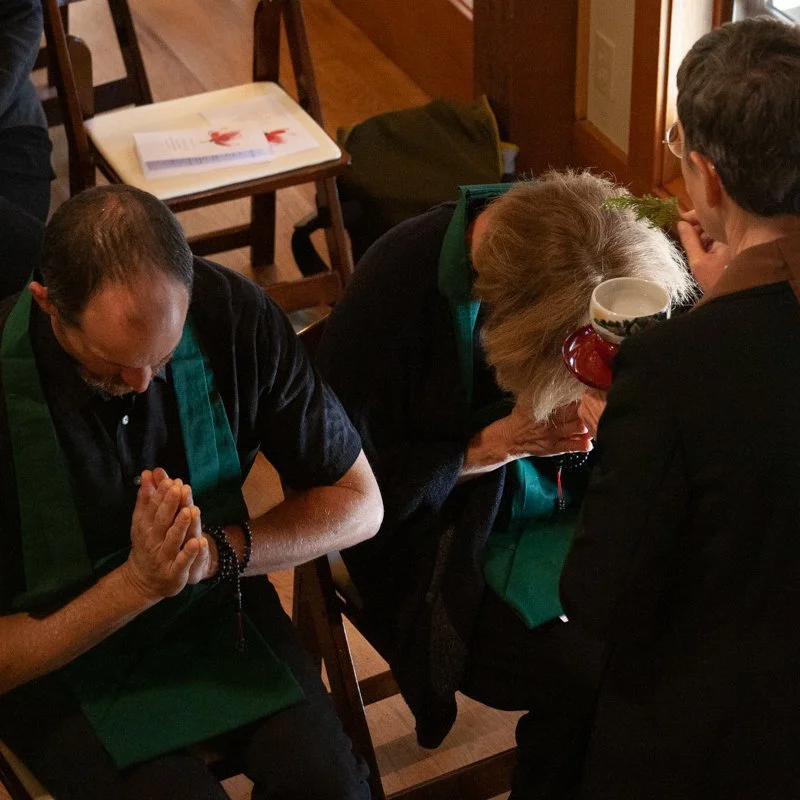
When we entrust a Dharma Teacher, we are literally placing our trust — as teachers, the trust of the Dharma, and the trust of the Sangha — in that person. It is a grave responsibility, and a real one.
An Entrusted Dharma Teacher becomes an ambassador who expresses, in all situations, the essential quality of Appamada: mindful, energetic care — care for all beings, care for the Sangha, care for the Dharma.
In the Soto Zen tradition there was historically no provision for authorizing Dharma teachers who had not first been ordained as priests, and in Japan this remains the case. In the West, conditions are different. Most serious practitioners are not monks but householders, deeply committed and often with decades of devoted practice. The Suzuki Roshi lineage developed a ceremony for entrusting lay students as teachers, and Appamada inherits this lineage.
An inside-out curriculum.
Appamada's path of entrustment is an inside‑out curriculum — a blossoming from a life of practice rather than a course of study imposed from outside. It honors the organic growth of each person individually, rather than tying them to stakes and trellises of our design.
Our training methods cannot be standardized, as they might be in a training monastery. They are, rather, a form of art and skillful means in a dynamic web of relating — a web that includes teachers, spiritual friends, the Sangha, families, workplaces, and the great world beyond. It is a process that dismantles ambition and striving while fueling aspiration and vow.
We have to remind ourselves, over and over, not to pin down the wings of living butterflies, not to make a sangha into a school. Dharma teachers are an emergent phenomena in a healthy Sangha — a complex, adaptive ecosystem.
The natural path.
A natural path has taken shape at Appamada through which experienced practitioners gradually mature toward entrustment. It is the actual architecture of how someone becomes known as a teacher here, and it unfolds across many years.
Experienced practitioners with an aspiration to support the community are invited to join a Council. The Councils together recommend students to serve as Head Student for a Practice Period. Those who have served as Head Student may, after consideration of their maturity and engagement, be invited to become Zen Mentors — meeting with Sangha members for brief practice discussions, training people in roles, offering orientation, and giving Dharma talks. As Zen Mentors mature, and through mutual understanding with the teachers, they may be invited to the Dharma Entrustee path — and eventually to Entrustment as a Dharma Teacher.
Each step on this path serves three functions: it gives the practitioner deeper experience in the path of teaching and leadership; it provides an opportunity for discernment — by the student, by the teachers, and by the Sangha — about the appropriateness of this person for the teaching path; and it gives the Sangha opportunities to experience this person in teaching roles, building familiarity and acceptance.
When more than one practitioner is on the entrustment path, they come together as a peer cohort. This weaves the fabric of mutual peer support and care, at each level, from Sangha member to Entrusted Dharma Teacher. We understand this quality of peer connection and mutual care as an essential ethical, practical, emotional, and spiritual support. It helps safeguard the integrity, sustainability, and continuity of the Sangha.
The Natural Path
From sangha member to entrusted teacher.
member
Student
Mentor
Entrustee
Teacher
What we watch for.
We watch, over years, in many circumstances, both in the Sangha and in candidates' lives. We are not watching for something in particular. We are simply watching, as they show us, over time, who they are.
What we are looking for cannot really be codified. There is integrity, devotion to one's spiritual path, dedication to the Sangha, and a natural — even if unrecognized by oneself — capacity for teaching. People are drawn to such a person, seek them out. They face their own conditioning, mistakes, and difficulties with curiosity. They work closely with a teacher and have an appetite for learning in the Dharma. They do not incite or foster division, conflict, gossip, or competitiveness in the Sangha.
Among the qualities and conditions we hold in mind:
A serious daily zazen practice and deep maturity in one's own practice, relationally and spiritually. Psychological and emotional steadiness. Skills and capacities for teaching, often visible long before they are named. Care for the community and dedication to its well-being. Abiding in the Precepts as the foundation of ethical life. Deep engagement with the Dharma and a determination to keep studying. Regular, ongoing practice discussion with a teacher. "Seasoning" in the Appamada principles and environment — enough time to grasp what we are doing here and to commit to it. Willingness to take on, and to teach, any role. Willingness to serve on the Board if asked. Life circumstances that make a teaching commitment feasible. Service on a Council, which itself presupposes taking the Precepts, attending intensives, and sustaining consistent practice. Service as Head Student and as Zen Mentor. Participation in Jukai, with the sewing of a rakusu. And being viewed as a teacher by Sangha members, and as a strong candidate by the Councils and the Dharma Teachers — real agreement that this person will be a fine teacher, even as they continue to grow into the role.
The dimensions that mature.
Across the natural path, certain dimensions of practice deepen together. They are not a curriculum and they are not separate compartments. They are dimensions of what we watch develop, and what an entrustee is asked to cultivate in their own way.
Practice
& Forms
Teaching
Leadership
Dharma
Study
Zazen
Zazen is the center. Everything else grows from this. Without stable, serious sitting practice, nothing else on the path coheres. Entrustees sustain a serious daily zazen practice, deepen their study of shikantaza, and learn how to prepare for and integrate retreat intensives. They explore how zazen extends beyond the cushion into the continuity of attention in relationships, decisions, and ordinary life.
Practice and Forms ground the Dharma in the body and in community — chant leading, doan, timing, altar care, the voice that holds the zendo. Forms also include the rhythms of householder life: time, vocation, family, right livelihood, hospitality. And they include personal practice arts — rakusu sewing, flower arranging, calligraphy, altar creation — the disciplines through which beauty trains the heart.
Dharma Study provides the conceptual and historical grounding that supports and clarifies practice — the life and teachings of the Buddha; the Four Noble Truths and the Eightfold Path; the Pāramitās and the Brahmavihāras; the Satipaṭṭhāna Sutta; dependent origination, emptiness, and the Three Marks of Existence; the major sutras; the Zen ancestors; and the history of how the Dharma traveled from India to the West. This is practice-embedded study, where reading, inquiry, and teaching are integrated forms of learning.
Leadership in Zen is an expression of vow. Entrustees deepen their relationship to the Precepts and Bodhisattva vows as the living foundation of leadership, and engage seriously with Right Use of Power — recognizing power dynamics, navigating authority responsibly, and building trust through feedback and repair. They cultivate spiritual friendship, council practice, and conflict navigation, and work with diversity, equity, and inclusion as expressions of the Dharma. They develop the practical skills of organizational stewardship and turn to the pastoral responsibilities of a teacher: accompanying Sangha members through illness, grief, and life's hardest passages.
Teaching arises naturally from practice and requires skillful means. Entrustees develop the art of Dharma talk preparation and delivery, study principles of adult learning and facilitation, and are prepared to lead practice discussion within the appropriate scope of their role — listening deeply, discerning when to refer, and knowing the boundary between a friend's listening and a teacher's response. They are also introduced to koan facilitation with attention to safety, consent, and care.
What sustains the path.
What follows is not a list of requirements but a set of understandings. The path bears fruit when these are in place.
A serious daily zazen practice. Thirty to sixty minutes of sitting each day, at Appamada or at home — not as a discipline imposed from outside but as the ground that makes everything else possible.
Regular practice discussion with the same senior teacher, at least every two weeks. These are not casual check-ins. They are opportunities to work at the edges of practice, to bring what is unresolved, and to be accompanied through it.
Active engagement in a Council, and in the daily life of the Sangha. Entrustees are present — at morning zazen, at scheduled activities, at the events that hold the community together. They serve as doan, doshi, host, or care team member. They offer Dharma talks when invited. They take on the small things that keep the Sangha running, not because they are required to but because that is what being a teacher in formation looks like.
Peer practice discussion with other entrustees and council members. Roughly ten minutes each way, with feedback offered and received. The capacity to accompany another's practice — and to be accompanied — is itself part of what the path is forming.
Ongoing study and inquiry. Reading, reflection, and form practice in support of the curriculum. The Precepts, the Paramitas, and Right Use of Power are returned to again and again, and each return at a new stage of practice opens something different.
A living portfolio of practice. Not a formal record, but an accumulating one — practice notes, reflections, talk outlines, recorded teachings, traces of the work that is actually happening. The portfolio supports reflection along the way and serves as material for the conversations that mark significant points on the path.
Annual intensives. Concentrated immersions in zazen, service, ethics, and teaching. These repeat on an annual cycle, and over the course of the path each entrustee will engage them many times — each time at a different depth.
These are not obligations imposed from outside. They are the container that makes the work possible. They are also how an entrustee becomes visible to the Sangha — how the community comes to know this person over time, and to trust them.
What entrustment authorizes.
Appamada's lay entrustment lineage comes through the Suzuki Roshi tradition, which developed the ceremony so that householder teachers could be recognized in the West.
Entrusted Lay Zen Teachers may perform nearly all the functions of someone with Dharma Transmission — teaching, leading intensives, giving Dharma talks, offering practice discussion, and conducting ceremonies such as weddings and memorials. What still requires Dharma Transmission is performing jukai, teaching independently of one's lineage, and authorizing other teachers.
A vote for the future.
Each person's path to Entrustment has been unique. Each one continues to grow after Entrustment. So Entrustment is, in a way, a vote for the future — the future of the person and the future of the Sangha. We watch how someone has grown, and we trust how they will continue to grow.
Each entrustee has shown great courage and persistence in working with their own conditioning and using their practice well when meeting adversity and challenge — in life and in the Sangha. They have demonstrated a deep love of the Dharma and plunged into a lifelong inquiry into these teachings. Most of all, they have shown a deep, abiding commitment to the Sangha — selflessly offering their support and care, leading service, giving Dharma talks, conducting ceremonies, teaching classes and the Precepts program, offering practice discussion, and leading intensives. This is no small undertaking.
The path ends, when it ends, in a formal ceremony of Dharma Entrustment — a public placing of trust, witnessed by the Sangha, by other Dharma teachers, and by everyone whose practice has helped form this person.
Not every practitioner who walks this path will arrive at entrustment. Some will find that the path itself was the gift, that a season of deeper practice enriched their offering to the Sangha without leading to a formal teaching role. That outcome is not a failure. The path is worth walking for its own sake.
Beginning.
The entrustment path is not something one applies for. It is something one is invited into, by the teachers, after years of practice and many smaller invitations along the way — to Jukai, to Council, to Head Student, to Zen Mentor.
If you find yourself wondering whether this path may someday be yours, the answer is to keep practicing, keep showing up, keep working with a teacher, and let the natural path do its slow work.
For questions about the path, contact a Senior Teacher.