
WELCOME
What is Zen?
Zen is a practice of being present to your life with clarity, care, and honesty
A path, not a belief
The word "Zen" gets used loosely — in design, in marketing, in the vague sense of feeling calm. But real Zen practice is something more specific and more radical. It is the practice of coming back to this moment, exactly as it is, and meeting it fully.
Zen is a path of awakening that has been refined over two thousand years. It began with the Buddha's own practice in India, traveled through China and Japan, and arrived in the United States through teachers like Shunryu Suzuki and Charlotte Joko Beck — both of whom are part of our own lineage at Appamada. But Zen doesn't ask you to study its history or adopt its language. It asks you to sit down and pay attention to your life.
This is not a belief system. There is no creed to accept, no doctrine to memorize. As Joko Beck says, this practice has been around for over two thousand years, and the kinks have been worked out of it. It is an empirical practice: you try the experiment, and you observe the results.
LEARN MORE ABOUT ZEN →

Zazen is the heart of the practice.
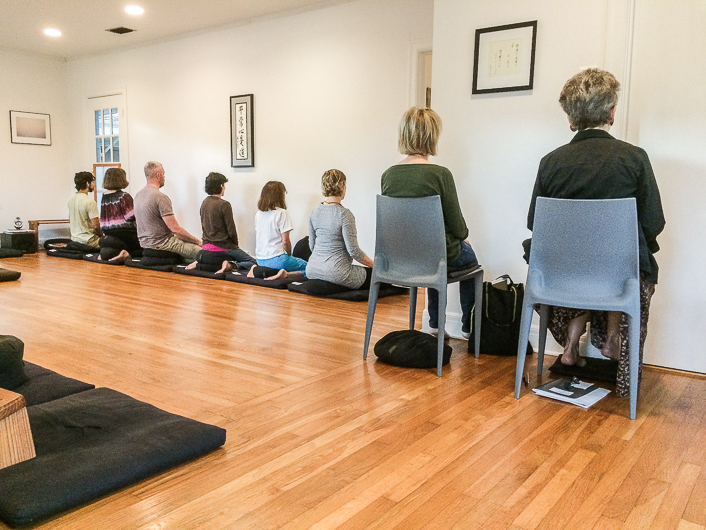
At the center of Zen is zazen — sitting meditation. You sit down, you become still, and you pay attention. Not to something special, but to what is actually happening: your breathing, the sounds around you, the sensations in your body, the movements of your mind. There is no need to stop your thoughts or reach a particular state. The opportunity is simply to abide in stillness.
We complement zazen with practice off the cushion, including regular meetings with a teacher, intensive retreats, participating in the life of the sangha — the community of practice — and deep inquiry into our everyday lives are essential complements to sitting. Zen living is abundant living, not austere ascetic detachment. It is the very fabric of your everyday life, and the lives of those you touch.
At Appmada, we practice Zen as relationality: we are in intimate relationship with ourselves, with other beings, with everything we experience, in this very moment.
READ Zazen instruction →
Visiting Appamada
The easiest way to start is to come to our Sunday morning orientation at 8:00 AM. But you can come to any program, any time.
Sunday morning
Orientation at 8:00 AM — a brief, friendly introduction. Stay for zazen at 9:00 and dharma talk at 10:20. We'll show you everything you need to know.
Weekday mornings
Each weekday morning we offer two sessions of zazen, one at 6:30 AM and another at 7:05 AM, which leads into a short service until about 7:45 AM. Please be seated five minutes before the sit begins.
What to wear
Comfortable, modest clothing in muted colors. Avoid shorts, sleeveless tops, loud patterns, or clothing with writing. We sit on the floor, so loose pants or a skirt are helpful. Chairs are available. Please avoid perfume and noisy jewelry.
What to bring
Nothing. Cushions, benches, and chairs are provided. You may want a sweater — the zendo can be cool in the morning. Silence your phone before entering.
If you arrive late
Use the back door and take a seat in the side room. Enter the zendo at the break between sitting periods. Please don't enter or leave during a sitting.
Online participation
All programs marked "Zoom" on our calendar are accessible from anywhere. We consider you fully included, just as if you had walked through the door. See our practice guidelines for more.
Getting here
913 East 38th St., Austin, TX 78705. Street parking on 38th and surrounding streets. Just north of the UT campus.
Read our practice guidelines →
Ready for more?
Here are some resources as you explore practice.
A single page that gathers the heart of Zen Buddhist teaching—the four noble truths, the eightfold path, the precepts, the four vows, etc. —into one clear, accessible reference you can return to again and again.
Zen Terminology
A friendly and thorough guide to the language of Soto Zen—from altar to zazen—to help you feel at home in the zendo by sharing the terms, roles, and concepts they may encounter.
Our Daily Chants Explained.
A guide to the chants practiced each morning at Appamada—explaining the meaning, history, and heart behind each one.
The Buddhist precepts are a set of ethical guidelines that practitioners take up not as rigid rules but as an ongoing, wholehearted practice of living with greater awareness and compassion toward all beings.
First Books
Any one of these will open the door. Links go to bookshop.org, which supports independent booksellers.
Everyday Zen
Bookshop.org ↗Nothing Special
Bookshop.org ↗The Feeling Buddha
Bookshop.org ↗Buddhism Plain and Simple
Bookshop.org ↗Living by Vow
Bookshop.org ↗Waking Up to What You Do
Bookshop.org ↗Zen Mind, Beginner's Mind
Bookshop.org ↗Bring Me the Rhinoceros
Bookshop.org ↗